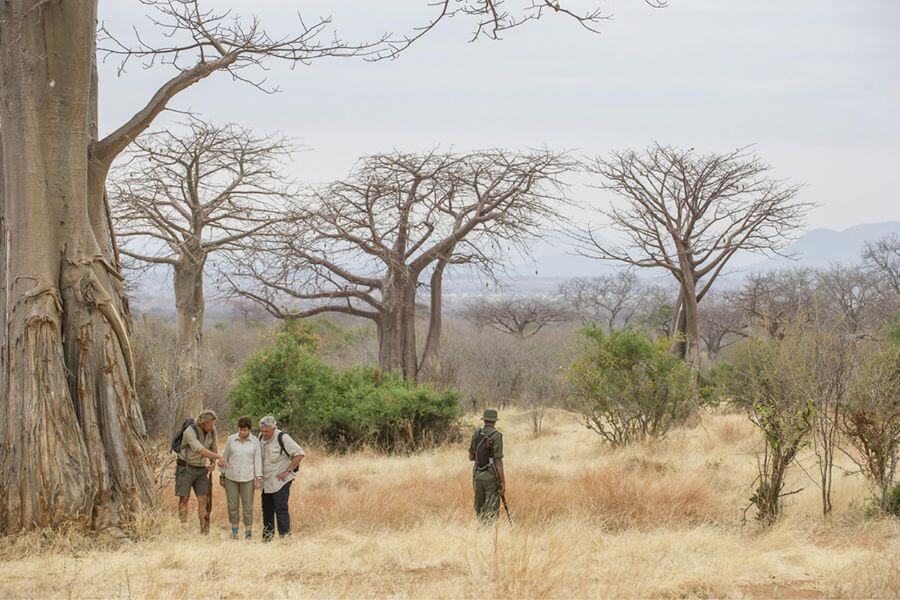
Giants? What kind of giants are found in Ruaha? Africa’s giants is the answer: mighty baobab trees, the largest herds of elephant in East Africa and one lion in every ten on the continent. Full of Africa’s biggest animals, Ruaha National Park is Tanzania’s answer to the rocky, wooded landscapes of Southern Africa and contrasts perfectly with the open plains of the Serengeti.

The secret behind Ruaha’s bio-diversity lies in the fact that it sits – ecologically – between East and Southern Africa, bringing together two main habitats. Cheetah and wild dog hunt on Ruaha’s grasslands; lion, leopard and hyena prowl the open woodlands. There are rivers and wetlands too, with hippo, crocodile and buffalo. Such a mix of habitats also means a huge range of birds, reflected in the park’s recorded bird list of over 500 species.
There are several accommodation options in the park, permanent lodges as well as mobile tented camps, and the standard of service and guiding is high. With prices set at a fairly high bar but not off-the-scale luxury, Ruaha accommodation is suited for couples and honeymooners on a midlevel budget as well as families with older children.


Day and night drives in open-sided 4X4 vehicles are the main safari activity offered at Ruaha’s lodges; keen photographers will be interested in lodges that provide customised vehicles for photography: fold-down sides for eye-to-eye imagery, camera rests and 360° swivel seats.

Ruaha is also a destination where you can lace up your boots and go walking, accompanied by an armed guide and ranger. Now you can really see Africa’s natural details: animal footprints, dung beetles, pollinating insects, and birds going about their business: a complete, non-impact immersive experience.
You’ll need to time your visit to Ruaha in order to get the most out of the park, especially for what you may want to see or experience. Firstly, avoid the heavy wet season: the first two months of it – January and February – can be okay but most camps close down between March and May. The drier months of June through October offer the best combination of comfort and wildlife watching, especially at the end of the dry season (September and October).

The rains begin in November and December, turning the landscape green and triggering a mass birthing of several antelope species. Migrant birds are arriving and predators are on the hunt – it’s a good – and cheaper – time to go to Ruaha and coincides with the Serengeti’s calving season.
So why isn’t everyone there? Indeed, only a fraction of safari travellers to Tanzania visit Ruaha, principally because this national park lies in the south of Tanzania rather than the north where you’ll find the familiar ‘northern circuit’ destinations: the Serengeti, Ngorongoro Crater and Tarangire. Ruaha National Park, on the other hand, lies on the ‘southern circuit’ along with Nyerere National park (formerly the Selous) and the rainforests of the Mahale Mountains.

The trick, of course, is to combine the best of both circuits: who wouldn’t want to miss out on the wildebeest migration in the Serengeti or the Big Five of the Ngorongoro Crater? Short domestic flights connect all the dots and by putting Ruaha with the best of the northern circuit, you now have one of the most diverse and rewarding safaris in Africa. Add on a beach holiday to Zanzibar at the end and it’ll be a safari you won’t forget.